 Kawi
Blog · With your family
St Nicholas in Luxembourg: Kleeschen, explained for parents.
In late November, your child comes home from school talking about Kleeschen, and you find out that slippers will soon need to go outside the bedroom door. St Nicholas is the celebration young children look forward to most in Luxembourg, often more than Christmas. Here is how it unfolds, what changes at school, and the words to learn with your child, alongside our guide to bringing the language into your home.
When does Kleeschen come?
Kleeschen is St Nicholas. He comes on the night of 5 to 6 December, and on 6 December, Kleeserchersdag, children wake up to see what he has left. In many families the slippers wait outside the door for several evenings before the date, and a sweet sometimes appears early.
Slippers, a present and twigs
In the evening, your child puts their Schlappen, their slippers, outside the bedroom door. In the morning they find sweets and often a small present, a Kaddo. Tradition has it that the Houseker, Kleeschen’s dark companion, leaves a few twigs for children who have been less good. Today he is mostly part of the story: he punishes no one.
At breakfast on 6 December, many families eat a Boxemännchen, a little man made of brioche. To fill the slippers, keep to sweets, a piece of fruit and a small present: the ritual matters more than what is inside.
A letter to Kleeschen
Every year, as the celebration approaches, POST Luxembourg opens the Kleeschen secretariat. Your child draws or dictates a letter, and you post it without a stamp in any yellow letter box. The address used in recent years is “Kleeschen, 1 Spillstrooss, L-3290 Am Himmelsland”. Write your sender address clearly: it is what lets your child receive a reply, with a small surprise. The letter template and this year’s dates are on POST’s Post4Kids page.
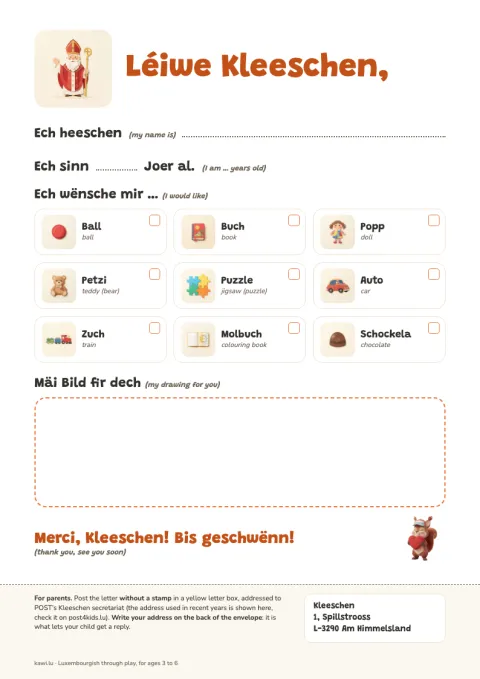
Our letter to Kleeschen, ready to print. Designed for a child who cannot write yet: they tick the illustrated presents, with their Luxembourgish names, and draw. The POST instructions are at the bottom of the page.
Download the letter (PDF)Kleeschen is not Father Christmas
It is often the first question from a child who grew up elsewhere. Kleeschen is a bishop: white beard, red robe, a mitre on his head and a crosier in his hand. Father Christmas exists in Luxembourg too, and he comes on 24 December. Two characters, two dates, and a child can happily wait for both. The official presentation of Kleeschen on Luxembourg’s national portal describes him the same way.
At school and daycare: a visit and a day off
In many classes and daycare centres, Kleeschen visits in person around the celebration, with a little bag for each child. The news often comes through the school notebook, sometimes only in Luxembourgish: look for the word Kleeschen.
Primary school classes have the day off on St Nicholas Day. In 2026, 6 December falls on a Sunday, so the 2026-2027 school calendar has no extra day off. In 2027, the day off will be Monday 6 December. The official dates are on guichet.lu’s school calendar.
The Kleeschen songs
Before the visit, children learn a song at school to welcome Kleeschen. Parents often look it up as Kleeschen Lidder. Along with the lantern song of Liichtmëss, it is one of the first Luxembourgish texts a child knows by heart, and they will want to sing it to you. To join in, we have gathered the Luxembourgish nursery rhymes to sing together.
The words to learn together
- Kleeschen: St Nicholas.
- Houseker: his companion, the one with the twigs.
- Schlappen: the slippers left outside the door.
- Kaddo: a present (plural Kaddoen).
- Kleeserchersdag: St Nicholas Day.
Kleeschen opens the year of celebrations. What comes next, from Liichtmëss to the Schueberfouer, is in our calendar of celebrations seen from the classroom.
Your first St Nicholas in Luxembourg
Put the slippers out, even if the tradition is new to you. Your child will talk about it at school the next day and will not want to be the only one who found nothing.
Keep it simple. A few sweets and a small present are enough: the ritual matters, not the size of the parcel.
Ask them to tell you about the visit at school. In Luxembourgish if they like: it is the day they are proud to know words you do not know yet.
The words of their celebrations, pronounced right.
Kawi introduces everyday Luxembourgish words through play, with the pronunciation of the official dictionary.